
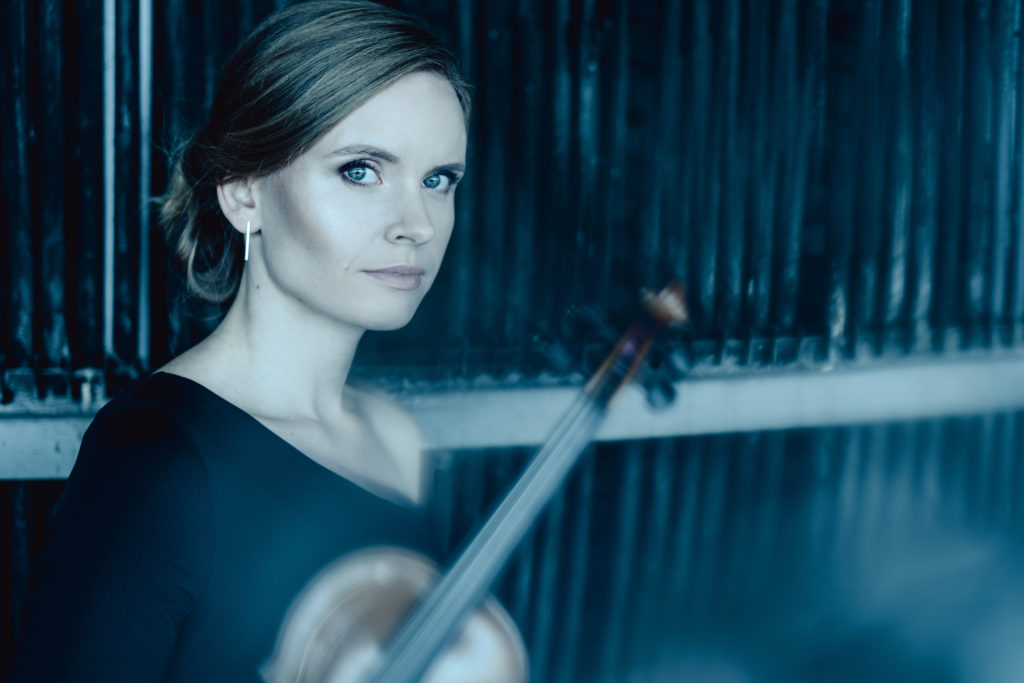
Oriana Masternak – violinist, chamber musician, organizer of artistic events, Head of the Department of Violin and Viola at the Krzysztof Penderecki Academy of Music in Kraków, professor of art (she received the title at the age of 39, one of the youngest in Poland).
A multi-award-winning interpreter and scholar of Polish music, both forgotten and contemporary, she regularly performs as a soloist and, above all, as a chamber musician in Asia, the Americas, and most European countries, presenting a versatile repertoire encompassing masterpieces from all periods as well as premieres of works dedicated to her. Critics emphasize that her playing is characterized by “beautiful sound, exceptionally rich timbres, impeccable intonation, and natural phrasing.”
To date, she has played over 700 concerts, including at festivals such as the Norfolk Chamber Music Festival (USA), FestivalPablo Casals (Prades), Mozartiade (Augsburg), Kalkalpen Festival (Grossraming), Pacific Music Festival (Sapporo), 21st Frühling Wiener Festival (Konzerthaus, Vienna), Warsaw Autumn, and Sacrum Profanum. In January 2012, Oriana performed at the famous Musikverein in Vienna, in November 2014 at the Pushkin Museum in Moscow, and in December 2015 at Carnegie Hall in New York. In the fall of 2019, she was invited to perform 13 recitals of Polish music in the most prestigious concert halls in China (with Justyna Danczowska at the piano). As a soloist, she has performed with orchestras conducted by, among others, Maciej Tworek, Marek Moś, Ernst Kovacic, Lilianna Krych, and Maria Bazou. She has premiered nearly 40 new music pieces by Polish and international composers. Since 2014 she is a member of Messages Quartet – one of Poland’s leading string quartets.
She has won numerous awards at national and international competitions, including those in Bulgaria, New York, Vienna, the Netherlands, Italy, Krakow, and Lodz. She has also received scholarships from various organizations, including the “Young Poland” Scholarship Program, the Polish Ministry of Culture and National Heritage, the European Chamber Music Academy, the Louise Willson Scholarship (Yale University, USA), the Pacific Music Festival in Japan, the Adam Mickiewicz Institute, Thomastik Infeld, the “Sapere Auso” Małopolska Scholarship Foundation, and the Krakow Creative Scholarship. A multiple Fryderyk Award nominee, in 2022, together with the Messages Quartet, she won the main prize at the “Musical Eagles” International Competition, and a year later, the quartet was nominated for the Coryphaeus of Polish Music in the Personality of the Year category. In 2023, she was awarded the Honorary Badge of Merit for Polish Culture, and in 2024, she was again a laureate of the “Musical Eagles” competition.
She studied at the Academy of Music in Kraków (diploma with distinction in the class of Prof. Roman Reiner), the Koninklijk Conservatorium in Brussels, the European Chamber Music Academy, the Yale School of Music (USA), and the University of Music and Performing Arts in Vienna. Her artistic mentors include Johannes Meissl, Katalin Sebestyen, Małgorzata Skorupa, Magdalena Szczepanowska, and the Tokyo Quartet.
She has recorded numerous times for Polish Radio (including as part of the “Miejscówka z Dwójką” series) and television. She is a constant presence in the media, giving interviews to Polish Radio Channel 2, Radio Kraków, Radio Kraków Kultura, TV Kraków, TV Wrocław, and other press titles. She has a rich phonographic output, including over 15 albums. In 2014, the Academy of Music in Kraków released her debut album, featuring works for violin and piano by Lucien Durosoir (with Sławomir Cierpik at the piano), while 2017 saw the release of the album “Philipp Scharwenka. Music for Violin and Piano,” released by Acte Prealable (with Sławomir Cierpik at the piano). Oriana has also recorded for DUX (the complete string quartets by S. Laks performed by the Messages Quartet and the album “Messages”), SOLITON, and the UMFC. In 2021, DUX released two albums: “Parallels” (Justyna Danczowska on piano) and the Fryderyk Phonographic Academy Award-nominated “Bacewicz/Tansman – Piano Quintets” (Julia Kociuban and Messages Quartet). In 2023, DUX released an album featuring Polish clarinet quintets (Piotr Lato and Messages Quartet).
As a musical life animator, she has completed nearly 30 projects (concerts, scientific and artistic sessions, cultural initiatives). She is the originator and organizer of the “Musical Interventions” and “Przedwiośnie Młodych” series, the “Faces of the Violin” conference, the “A Due” festival, and numerous individual events. She regularly publishes in “Ruch Muzyczny.” Her research focuses on lesser-known Polish music and the Krakow violin tradition. In 2024, she received a prestigious research grant from the National Science Centre’s Sonata Bis program and launched the project “Kraków Violin School – Origins, Idiom, Prospects for Development,” which examines the nearly 140-year-old performance tradition of the Krakow violin community. The project includes compiling source materials, recordings, and interviews, as well as documenting the interpretations of contemporary violinists, making the unique knowledge of the Krakow Violin School available to a wide audience.
Oriana Masternak teaches violin at the Krzysztof Penderecki Academy of Music in Kraków. She has also served as a juror at the Macroregional Secondary School Chamber Music Auditions in Gdańsk, the International Music Interpretation Competition in Krasiczyn, the OPUS International Music Competition, the J. Stanienda Inter-University Violin Competition in Warsaw, the “Janko Muzykant” International Violin Competition in Sochaczew, and the National Competition for Young Instrumentalists in Jasło. She has led master classes in Poland and abroad (including in Spain, Georgia, and Brazil). For several years, she has been a lecturer at the Małopolska Academy of Talents in Łąck, as well as at the International Music Courses in Łańcut, the Summer Academy of Music in Kraków, and the “Jak Wieniawski” Courses in Kazimierz.
As an artist and educator, Oriana Masternak is guided by the belief that music should be grounded in the present, yet faithful to its historical contexts. She views art as a language – one that speaks, conveys emotion, and at the same time guides the listener in a thoughtful and conscious manner. As she herself emphasizes: “Performance is a responsibility. Our task is to present each piece of music in a way that delights the listener. I am a person who enjoys knowledge. I study treatises and musical literature because the more I know, the freer I feel – and this freedom allows me to convey music in a conscious way, full of expression and the composer’s true intention.”
The artist plays a Sebastian Lang instrument from 1788.